Showing posts with label Galaxy Nexus. Show all posts

Tuesday, 24 December 2013

Kitkat 4.4 Update for Galaxy Nexus

Kitkat 4.4 Galaxy Nexus
For more than a year, Android enthusiasts waited for Google to unveil the next iteration of the mobile operating system to succeed Jelly Bean. It was widely thought (even within Google) to be called Key Lime Pie. Instead, a bizarre marketing partnership was struck that gave us Android 4.4 KitKat, officially unveiled on Halloween in the United States at the same time as the first device to run it – Google's new Nexus 5. 

Unfortunately, those of you with a Galaxy Nexus can kiss your KitKat flavored dreams goodbye. Google has confirmed that the less than two-year-old phone won't be getting Android 4.4. Google doesn't have minimum hardware requirements for Android 4.4. Even so, the company made a big deal about the fact that KitKat can run comfortably on 512 MB of RAM and the Galaxy Nexus has twice that. Of course, you could always get around this sad fact by rooting your device and running a custom Android 4.4 ROM. If you don't want to do that and desperately want KitKat, there isn't much you can do beyond buying a new phone. Cyanogenmod Team has started their focus on developing Kitkat to run on Galaxy Nexus perfectly. Currently the ROM is still in beta stage but surely, it won't take long to get the stable full functioning ROM. CM ROM is always reliable. That's why it is recommended in this post to install CM 11 ROM to taste the Kitkat.

A close look at KitKat's new home screen, Google Now is always your left-most home screen. The dialer gets a new look. Google voice control is easily accessed by saying 'OK, Google'.

A Whole New Look
The moment you first see the new home screen in KitKat, the improvements are apparent. The fonts appear smaller and more slender, while several newly redesigned app icons have grown a bit in size. The biggest visual change for most users, while still subtle, is likely to be the addition of a more fully transparent background to the top status bar, the on-screen buttons on the bottom of the home screen, and the app drawer.

The result is a user experience that seems a little more unified and grounded in the home screens and is somehow warmer. It's kind of nice not to be launching apps from the black void of a background-less app drawer.
home screens and the app drawer on KitKat
The new look of home screens and the app drawer on KitKat
This line of thought also carries over to the revamped lock screen in KitKat, which now offers more complete control over media that's playing without having to go through the unlocking process, and also displays album art attractively in another nice visual touch. Other small aesthetic tweaks can be found throughout KitKat, notably a new look for the clock app and the download manager, which now comes with an optional grid view.

Another change that might make sense from a holistic design perspective but needlessly removes some handy bits of functionality is the move to "de-blue" a number of icons throughout KitKat. For example, in the status bar, the Wi-Fi and cell network activity icons no longer turn blue to indicate the presence of data connectivity. Instead, they're always gray when present and there's no longer a means of checking your network data status at a glance. Previous actions like keyboard presses that may have previously resulted in blue highlights have also gone gray in KitKat.
Kitkat Lock Screen
The new lock screen displays album art of currently playing media
A few other features are newly hidden in this update, which caused a little confusion for me. The widget drawer in KitKat has been divorced from the app drawer and is accessed by long-pressing on any blank area of a home screen, which will bring up Google settings, wallpapers and widgets.

There's also no immediately obvious way to add home screens. It has to be done by selecting and dragging an app, either from an existing home screen or the app drawer, to the right edge of the screen, which then either scrolls to the next screen to the right, or creates a new one. But what if you want to add a new home screen all the way to the left, you ask? No dice, and here's why:

Google Now Has A New Home
Kitkat Google Now
Google Now is always your left-most home screen
From the home screen, if you swipe left, you'll always eventually land on the Google Now screen displaying all your personalized cards and the search bar.

KitKat has baked Google Now, search and voice control deeper into Android than ever before. Once you're past your lock screen you can say "OK, Google" at any point to trigger Google Now's voice control and start barking out commands and searches. As mentioned earlier, you can also adjust settings for Google Now, search and voice control by simply long-pressing on any home screen empty space.

While the left-most Google Now home screen can't be removed, KitKat does allow for management of any home screen replacements that you might install. You switch between them in the "Home" section of Settings.

Revamped Apps
A number of native Android apps get new treatments in KitKat, starting with Hangouts, which has swallowed text messaging in the process. This is probably my least favorite "improvement" in Android 4.4 – combining SMS and Google Hangouts (which itself had already swallowed Google Talk and Chat in earlier versions) isn't intuitive at first and it can be confusing to know which method of communication you're actually using to contact someone.
Kitkat Hangouts
Hangouts and SMS are now the same app
Did you just SMS or IM your cousin about the movie that starts in five minutes? In Hangouts it's easy to confuse the two, leading to potential headaches. Combining these functions into one app isn't necessarily a bad idea, but it's not well-executed in the current iteration.

The next big change is seen in the phone app, which attempts to shift the focus away from the dialpad, encouraging you instead to search for contacts and businesses via both the web and locally on your device. The dialpad is still there, but it's just not the first thing you see, and when you click on its icon, it overlays itself over the search window instead of taking the full screen.

When you receive a call that isn't in your local contacts, Google now introduces its own form of caller ID by cross-checking the incoming call number with Google Places. So if the call is coming from an existing business, it's likely that you'll be able to see which one is calling you in KitKat, which is a nice little bonus.
Kitkat Caller ID
Caller ID is provided by Google Places
The email app in KitKat has also been refreshed with nested folders and better navigation, and there's also a new app for Photos, which is actually kind of strange because it's basically the same as the old Gallery app, but with the updated KitKat look. What's strange is that the old Gallery app is also still here in 4.4, but the camera app has been broken out to stand on its own. So enjoy the extra place to browse your photos, I guess.

Finally, some new power-saving features allow KitKat to be less demanding on devices. A special low-power mode can allow for up to 60 hours of continuous audio playback, and new location modes allow you to keep track of your whereabouts when you need it and without having to manually toggle GPS and network settings to save battery when you don't.

Let starts the tutorial of installing Cyanogenmod 11  on Galaxy Nexus
NOTE: Need to be on the latest version of CWM  Recovery.

  • Download Cyanogenmod 11.zip and Kitkat Gapps.zip & copy to phone.
  • MAKE A BACKUP!!!
  • DO A FACTORY RESET!!! - this will wipe data & cache! 
  • Go to install zip from sdcard
  • Choose zip from sdcard
  • Select Cyanogenmod 11.zip 
  • Confirm
  • Repeat Steps 5 -8 for gapps
  • Reboot

Whats Working??

  • Everything it seems
Read more

Friday, 16 August 2013

Jelly Bean 4.3 Update Samsung Galaxy Nexus

Jelly Bean 4.3 Update Samsung Galaxy Nexus

Jelly Bean 4.3 Update Samsung Galaxy Nexus has been released already. I installed Jelly Bean 4.3 Update Samsung Galaxy Nexus on my device about two weeks ago and found some distinct features compared to Jelly Bean 4.2.2.

You probably want to know what new features Jelly Bean 4.3 Update Samsung Galaxy Nexus brings. The followings are the complete list of new features of Jelly Bean 4.3 Update Samsung Galaxy Nexus.


Android 4.3 Jelly Bean Restricted Profiles on tablet


Android 4.3 Jelly Bean Restricted Profiles are similar to Kids Corner on Windows Phone. The feature of Android 4.3 Jelly Bean Restricted Profiles lets you manage the apps and content which is accessible on a certain user account.


Android 4.3 Jelly Bean Restricted Profiles enable parental controls, so certain family members are prevented from accessing mature content. 


Android 4.3 Jelly Bean Bluetooth Smart support (Bluetooth Low-Energy)

As expected, version 4.3 brings low-energy Blutooth which has been dubbed Android 4.3 Jelly Bean Bluetooth Smart. Android 4.3 Jelly Bean Bluetooth Smart support minimises the amount of power used when connecting Bluetooth accessories and also measures the data being transmitted.


Android 4.3 Jelly Bean OpenGL ES 3.0 support

4.3 Jelly Bean adds support for OpenGL ES 3.0, the latest standard for accelerated 3D graphics. Android 4.3 Jelly Bean OpenGL ES 3.0 brings photorealism to a whole new level in the games you're playing: blades of grass on the soccer field come alive, asphalt on the street looks real as you screech by, stubble on a villains' face almost pokes out of the screen.


Android 4.3 Jelly Bean Dial pad autocomplete

If you start typing numbers, Android 4.3 Jelly Bean Dial pad autocomplete will suggest contacts or numbers to call.


Android 4.3 Jelly Bean Languages


Android 4.3 Jelly Bean Language has improved its support – namely Hebrew, Arabic and Hindi. Android 4.3 Jelly Bean Languages enable right-to-left layouts across the platform user interface: dialer, home and lock screens, settings, and more. There's also added support for Afrikaans, Amharic, Swahili, and Zulu in Android 4.3 Jelly Bean Languages.


Jelly Bean 4.3 Update Samsung Galaxy Nexus Other new features and changes

Here's a quick list of all the other tweaks included in Jelly Bean 4.3 Update Samsung Galaxy Nexus.


Keyboard & input 

  • Easier text input - an improved algorithm for tap-typing recognition makes text input easier. 
  • Lower latency input for gamepad buttons and joysticks. 
Location 
  • Location detection through Wi-Fi - use Wi-Fi to detect location without turning on Wi-Fi all the time. 
Networking 
  • Bluetooth AVRCP 1.3 support - display song names on a car stereo. 
Settings 
  • Disabled apps tab - check which apps are disabled in Settings > Apps. 
System 
  • Restricted profiles - put your device into a mode with limited access to apps and content. 
  • Setup wizard simplification - getting started on Android is easier thanks to the ability to correct previous input, and because of streamlined user agreements. 
  • Faster user switching - switching users from the lock screen is now faster. 
  • Enhanced photo daydream - navigate through interesting albums.
How to flash Jelly Bean 4.3 Update Samsung Galaxy Nexus

Preparation:
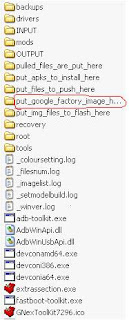
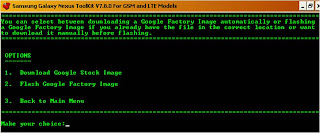
  • Download Galaxy Nexus Toolkit and install it.
  • Install Galaxy Nexus Drivers onto your computer. [Provided in the GNex Toolkit]
  • Download Galaxy Nexus Jelly Bean Update [4.2.2]
  • Copy downloaded file to "put_google_factory_image_here" inside Galaxy Nexus Toolkit
  • Enable USB Debugging in setting/developer options and then connect your device with USB cable.
Instruction
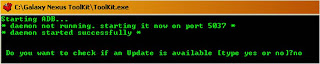
  • Execute ToolKit.exe
  • Type "no" if you are prompted to check the newer version
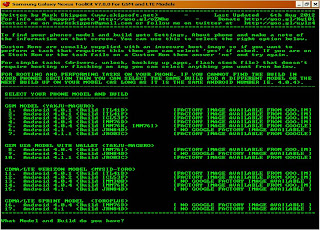
  • Select your device type. Download Android System Info in Google Play to check your device type.
  • Type 3 to unlock bootloader
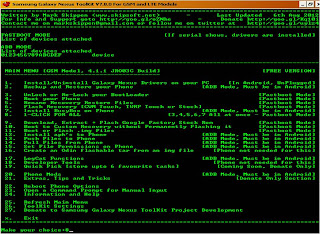
  • Follow the on screen instruction. If you are prompted about Fast Boot Mode and Insecure Boot Image, just Type "no" and the computer will do it for you. Your device will reboot several times, just wait until the process finishes. The toolkit will come back to main menu (picture above).
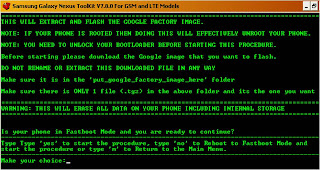
  • In the main menu type 9 to flash google factory stock rom
  • Type 2 to Flash Google Factory Image.
  • Type "no" to reboot your device to Fast Boot Mode.
  • The process of flashing will start, you can see the process on the Galaxy Nexus Toolkit.
  • Wait the process to finish. Your device will boot up when it finishes.
  • Fill your identity and gmail address.
  • Enjoy the new version of Android.

Read more

Thursday, 13 June 2013

Unlocking Bootloader Samsung Galaxy Nexus Jelly Bean 4.2.2

Unlocked Bootloader
Unlocked Bootloader Samsung Galaxy Nexus Jelly Bean 4.2.2
Unlocking Bootloader Samsung Galaxy Nexus Jelly Bean 4.2.2 is requisite before you can install Clockworkmod Recovery [CWM], root your device and update your android version to the newest version. Locked Bootloader restricts your access to the system files of Samsung Galaxy Nexus Jelly Bean 4.2.2 and disable your ability to hack the device to make necessary modification. You can compare the Unlocked Bootloader of Samsung Galaxy Nexus Jelly Bean 4.2.2 picture above with the one on your device.

The process of Unlocking Bootloader Samsung Galaxy Nexus Jelly Bean 4.2.2 is not so difficult and doesn't need special skill even for you who are not experienced in Android modification. 

Warning: to avoid bricking your phone you need to follow the steps carefully. I will not take any responsibility if your device can't boot. This is unlikely to happen if the steps are correct.

Unlocking Bootloader Samsung Galaxy Nexus Jelly Bean 4.2.2 will void your warranty. But don't worry since you can re-lock it again using the same process.


Unlocking Bootloader Samsung Galaxy Nexus Jelly Bean 4.2.2 Preparation: 
  • Download Galaxy Nexus Toolkit and install it.
  • 80% Battery to prevent power loss on the process that can damage your phone.
  • Enable USB Debugging in setting/developer options and then connect your device with USB cable.
FOR SAMSUNG GALAXY NEXUS JELLY BEAN 4.2.2 YOU NEED TO TAP THE BUILD NUMBER IN "SETTING ABOUT" SEVERAL TIMES UNTIL DEVELOPER OPTIONS SHOWS UP UNDER SETTING.

Steps of Unlocking Bootloader Samsung Galaxy Nexus Jelly Bean 4.2.2:
  • Execute Galaxy Nexus Toolkit
  • Type "no" if you are prompted to check the newer version
  • Select your device type. Download Android System Info in Google Play to check your device type.
  • Type 1 to Install Galaxy Nexus Drivers [skip this if drivers are already installed]
  • Type 3 to Unlock your Bootloader
  • Type 1 to Unlock Bootloader
  • Type 'no' to reboot to Fastboot Mode
  • Your device will restart. Once it goes into Fastboot Mode the process will start automatically. Pay attention to Galaxy Nexus Toolkit to see the process. When the toolkit goes back to main menu, that means the process has finished.
  • Now everytime you turn on your device you will see the Unlocked Bootloader on your Samsung Galaxy Nexus Jelly Bean 4.2.2. [Picture Above]
Do the same process if you want to Re-lock the bootloader Samsung Galaxy Nexus Jelly Bean 4.2.2 but this time you must select the 'Re-Lock Bootloader' option.


That's all about Unlocking Bootloader Samsung Galaxy Nexus Jelly Bean 4.2.2.
Good luck with the process.


Read more

[CWM] Clockworkmod Recovery 6.0.4.3 Galaxy Nexus Jelly Bean [4.3]

ClockWorkMod Recovery
Clockworkmod Recovery 6.0.4.3 Galaxy Nexus Jelly Bean [4.3]
Clockworkmod Recovery 6.0.4.3 Galaxy Nexus Jelly Bean [4.3] gives you more options in the Recovery Mode. Features of Clockworkmod Recovery 6.0.4.3 Galaxy Nexus Jelly Bean [4.3] include Nandroid backup, adb shell, advanced update.zip options (ignore asserts and signature checks), and file browser for choosing update.zips. Clockworkmod Recovery 6.0.4.3 Galaxy Nexus Jelly Bean [4.3] is one of the famous recovery replacements for android and has been used widely on the globe.

Installing Clockworkmod Recovery 6.0.4.3 Galaxy Nexus Jelly Bean [4.3] is necessary if you like changing ROMS and flashing KERNELS as well as other modifications to the phone system. To avoid damaging phone you are advised to make a Nandroid backup in case you experience system failure and your device can't boot as normal or some features and applications don't work well after the modification. Stock Recovery doesn't provide option for Nandroid Backup.

How to Install Clockworkmod Recovery 6.0.4.3 Galaxy Nexus Jelly Bean [4.3]
Preparation: 
  • Download Galaxy Nexus Toolkit and install it.
  • 80% Battery to prevent power loss on the process that can damage your phone.
  • Enable USB Debugging in setting/developer options and then connect your device with USB cable.
Steps:
  • Execute Galaxy Nexus Toolkit
  • Type "no" if you are prompted to check the newer version
  • Select your device type. Download Android System Info in Google Play to check your device type.
  • Type 1 to Install Galaxy Nexus Drivers [skip this if drivers are already installed]
  • Type 6 to Flash Recovery
  • Type 1 to Flash Clockworkmod Touch Recovery
  • Type 'no' to go into Fastboot Mode
  • Your device will restart. Once it goes into Fastboot Mode the process will start automatically. Pay attention to Galaxy Nexus Toolkit to see the process. When the toolkit goes back to main menu, that means the process has finished.
  • You can check CWM by booting into Recovery Mode. Turn off the phone and then hold together volume up + volume down + power button. Use the volume button to scroll among the options. Find Recovery Mode and use power button to confirm. [Picture on the top]
Read more

Friday, 23 November 2012

CyanogenMod 10.2 Nightlies Grabs a Slice of the Pie - Android 4.3 All Devices

CyanogenMod 10
CyanogenMod 10.2
NEW** 
Pie Controls come to CyanogenMod 10.2 Nightlies to give you more screen real estate


Pie Controls
CyanogenMod 10.2 Pie Controls 
CyanogenMod 10.2 is a free, community built, aftermarket firmware distribution of Android 4.3 (Jelly Bean), which is designed to increase performance and reliability over stock Android for your device.

There are two versions of 
CyanogenMod 10.2, namely stable and nightly.

What is Nightly build ?

Nightly build is the auto compiled build from the CyanogenMod 10.2 github each time there are new corrections on the stable version. This version changes every night.

There are no Google Apps bundled with 
CyanogenMod 10.2 ROMs, because Google asked Cyanogen to remove copyrighted apps from his roms. After flashing this CyanogenMod 10.2 ROM don't forget to flash Google Addon package if you want it.


Installation Instructions

  1. Root the device and install ClockworkMod Recovery. 
  2. Download CM 10 zip and JB Gapps zip from the links below. Download CyanogenMod 10.0.2 zip based on your device type.
  3. Put CyanogenMod 10.2 zip and JB Gapps zip on your phone sdcard. 
  4. Make a NANDroid backup of your current ROM.
  5. Put your phone into recovery mode (For Galaxy Nexus: Turn Off your device and hold volume up and down + power button together. Use volume button to move between options and power button to confirm.)
  6. Format the system data, dalvik, & cache of your device.
  7. Select update zip and select from sdcard. Then choose the CyanogenMod 10 zip.
  8. Flash also Jelly Bean 4.3 gapps zip. The same process with flashing CyanogenMod 10.2 zip.
Read more

Monday, 19 November 2012

CyanogenMod 9 Final Version - Android 4.0.4 All Devices

CyanogenMod 9
CyanogenMod 9 Final Version
CyanogenMod 9 Final Version is an open source replacement firmware for smart phones and tablet computers based on the Android mobile operating system. CyanogenMod 9 Final Version offers features and options not found in the official firmware distributed by vendors of these devices.

Features supported by CyanogenMod 9 Final Version include native theming support, FLAC audio codec support, a large Access Point Name list, an OpenVPN client, an enhanced reboot menu, support for Wi-Fi, Bluetooth, and USB tethering, CPU overclocking and other performance enhancements, soft buttons and other "tablet tweaks", toggles in the notification pull-down (such as Wi-Fi, Bluetooth and GPS), app permissions management, as well as other interface enhancements. According to CyanogenMod 9 Final Version's developers, CyanogenMod 9 Final Version does not contain spyware or bloatware. CyanogenMod 9 Final Version is also stated to increase performance and reliability compared with official firmware releases.


CyanogenMod 9 Final Version is based on Google's Android 4.0 Ice Cream Sandwich. Steve Kondik and his team have announced that they had begun work on the new release after Google released the source code of Android 4.0.1. Development on CyanogenMod 9 Final Version release took longer than with previous releases due to the significance of the changes between Android 2.3 "Gingerbread" and 4.0 "Ice Cream Sandwich", and the team took this opportunity to clarify their vision for the ROM and rethink any modifications which were no longer necessary due to improvements within Android.


By the last days of November 2011, some alpha versions of CyanogenMod 9 Final Version had been distributed, in particular for the Samsung mobile phones Nexus S and Galaxy S. On 9 August 2012, after various betas and release candidates, CyanogenMod released the finished version of Cyanogenmod 9. Major changes are seen on the interface of CyanogenMod 9 Final Version such as GPS, WIFI, Bluetooth and profiles are shown on the top of the notification area. Many changes are also on the setting where some new items were added. Overall, CyanogenMod 9 Final Version is faster than the stock rom.


Installation Instruction of CyanogenMod 9 Final Version


Preparation (First three are optional. If you want to start fresh, these can be skipped)
  • Install AppBak from Market, run it and save a list of all your apps.
  • Install SMS Backup and Restore from Market, run it and backup your SMS history.
  • Install Call Logs Backup and Restore from Market, run it and backup your call log history.
  • Boot into CWM6 recovery. Make a full backup. You will need this backup later if you decide to go back to your previous ROM and data.
  • WARNING: Many apps will Force Close crash if you restore data from a previous ROM.
Installing CyanogenMod 9 Final Version
  • Boot your phone into recovery mode. Warning: Only use CWM6 to flash CM9. Otherwise, you risk bricking your phone!
  • Wipe data, dalvik, and cache.
  • Flash CyanogenMod 9 Final Version.zip.
  • Flash ICS gapps.zip. You must flash gapps after every upgrade to CM9 since /system is formatted, wiping your previous add-ons.
  • Reboot phone.
  • After you setup your Google account, reinstall the three apps from Market in order to restore most of your apps, call log and SMS history.
  • Warning: Do not restore backup data of system apps!
  • If you restore a bad backup with cached settings in telephony.db in data/data/com.*.*.telephony it can break MMS.
  • It seems that restoring backups can also break Calendar sync.
Upgrades to CyanogenMod 9 Final Version

Upgrades from previous versions of CM9 are the same process as install, except you do not need to wipe anything. Contrary to popular belief, you do not need to even wipe cache and dalvik-cache when upgrading between CM9 versions. You only need to wipe if you are doing a major upgrade, switching to a different ROM entirely, or attempting to fix bugs caused by bad backups or corrupt app data.


Download CyanogenMod 9 Android 4.0.4
(Choose Based on Your Device Type and Select The Latest CM9 Version)
ICS Gapps CyanogenMod 9 Final Version
(Choose The Latest ICS Gapps Version)
Install CWM 6 (Instruction For Galaxy Nexus Only)
Read more

Thursday, 18 October 2012

Root Galaxy Nexus Jelly Bean [4.2.2]

Superuser App
Root Galaxy Nexus Jelly Bean [4.2.2]
Everyone wants to Root Galaxy Nexus Jelly Bean [4.2.2] since rooting gives them access to restricted system folder. After make an update to Jelly Bean official surely you'll lose your previous rooting file and your galaxy nexus goes back completely to factory state. It's necessary to root Galaxy Nexus Jelly Bean [4.2.2] again. Here is a brief explanation about rooting Galaxy Nexus Jelly Bean [4.2.2].

Rooting Galaxy Nexus Jelly Bean [4.2.2] is installing the root programs (the su program and the Superuser.apk app). These programs, in combination with each other, allow you to run other programs under the "root" account under Android. Programs that run under the root account are not restricted like normal apps are.

Advantages of rooting Galaxy Nexus Jelly Bean [4.2.2] include:
  • Overclocking
  • Underclocking which can help save battery for those times when you might not need the phone (i.e. sleeping, in the cinema, at school, etc)
  • Mods to improve battery life
  • Access to apps that might require superuser permission (i.e. Titanium Backup, DroidWall and SetCPU)
  • Removal of bloatware such as apps preinstalled by manufacturers or carriers
  • Deeper customization i.e. tweaks to the phone’s UI
  • Flashing ROMs such as CyanogenMod and MIUI
  • Gaining access to features that your carrier might otherwise have charged you a fee for i.e. WiFi/USB tethering (NOTE: if your carrier detects that you are doing this, they might charge you for it anyway so proceed at your own risk!)
Rooting Galaxy Nexus Jelly Bean [4.2.2] is not so difficult since we have a powerful software for rooting Galaxy Nexus Jelly Bean [4.2.2]. We don't need to do rooting Galaxy Nexus Jelly Bean [4.2.2] process manually since the tool does it for you. 

Tool that we need is Galaxy Nexus Toolkit 11.1.0 which is completely refined for Jelly Bean 4.2.2. Jelly Bean 4.2.2 needs new adb driver version and needs to be paired with computer before the computer can make some modifications onto the device. This new adb driver is included in this version of toolkit.

Preparation for Rooting Galaxy Nexus Jelly Bean [4.2.2]:

  • Download Galaxy Nexus Toolkit 11.1.0, install it and install the drivers.
  • Unlock the Bootloader
  • 80% Battery to prevent power loss on the process that can damage your phone.
  • Enable USB Debugging in setting/developer options and then connect your device with USB cable.
FOR ANDROID 4.2 YOU NEED TO TAP THE BUILD NUMBER IN "SETTING ABOUT" SEVERAL TIMES UNTIL DEVELOPER OPTIONS SHOWS UP UNDER SETTING.
Bootloader Unlocked
Bootloader Unlocked
Rooting Galaxy Nexus Jelly Bean [4.2.2]:
  • Execute Galaxy Nexus Toolkit
  • Type "no" if you are prompted to check the newer version
  • Select your device type. Download Android System Info in Google Play to check your device type.
  • Type 1 to Install Galaxy Nexus Drivers [skip this if drivers are already installed]
  • Type 4 to Root your device.
  • Type 1 to Root device.
  • Type 2 to install Super Su by ChainFire [ recommended for Jelly Bean 4.2.2] or type 1 for older versions of android
  • Type 'no' to reboot to Fastboot Mode
  • Your device will restart. Once it goes into Fastboot Mode the process will start automatically. Pay attention to Galaxy Nexus Toolkit to see the process. When the toolkit goes back to main menu, that means the process has finished.
  • Now in the phone Menu you will notice new app named 'Superuser' [Picture Above] DON'T Uninstall it. It gives permissions to any app which requests root access. If any app request root access, select 'allow'.
Superuser Request
Superuser Request
Do the same process if you want to do Un-Rooting Galaxy Nexus Jelly Bean [4.2.2] but this time instead of selecting 'Root device', you must select the 'Un-Root' option.

Read more

Wednesday, 17 October 2012

Jelly Bean 4.2.2 Update Samsung Galaxy Nexus

Galaxy Nexus
Jelly Bean 4.2.2 Update Samsung Galaxy Nexus 
Jelly Bean 4.2.2 Update Samsung Galaxy Nexus has rolled out. Jelly Bean 4.2.2 Update Samsung Galaxy Nexus  adds new features and some improvement in UI and system speed. Jelly Bean 4.2.2 Update Samsung Galaxy Nexus improves on the speed and simplicity of Android 4.1 and includes all new features – Photo Sphere and a completely redesigned camera app, new Gesture Typing keyboard, Google Now with all new cards, and much more.

Everything is fast, fluid, and smooth in Jelly Bean 4.2.2 Update Samsung Galaxy Nexus. Moving between home screens and switching between apps is effortless. Jelly Bean 4.2.2 Update Samsung Galaxy Nexus improves performance throughout the system, including faster orientation changes, quicker switching between recent apps, and smoother and more consistent rendering across the system through vsync and triple buffering.

Jelly Bean 4.2.2 Update Samsung Galaxy Nexus has more reactive and uniform touch responses, and makes your Android device even more responsive by boosting your device’s CPU instantly when you touch the screen, and turns it down when you don’t need it to improve battery life. To find out more information about Jelly Bean 4.2.2 Update Samsung Galaxy Nexus click here.

Ok Let's begin the upgrade process of Jelly Bean 4.2.2 Update Samsung Galaxy Nexus. Remember that this process of Jelly Bean 4.2.2 Update Samsung Galaxy Nexus will clean up everything inside your phone so mind to make a full backup of your apps, sms, or contacts first before you proceed. Make sure that your phone battery is full to avoid any error happens because of running out of battery. 


Preparation before Jelly Bean 4.2.2 Update Samsung Galaxy Nexus:
  • Download Galaxy Nexus Toolkit and install it.
  • Install Galaxy Nexus Drivers onto your computer. [Provided in the GNex Toolkit]
  • Download Jelly Bean 4.2.2 Update Samsung Galaxy Nexus
  • Copy downloaded Jelly Bean 4.2.2 Update Samsung Galaxy Nexus to "put_google_factory_image_here" inside Galaxy Nexus Toolkit
  • Enable USB Debugging in setting/developer options and then connect your device with USB cable.
Instruction of Jelly Bean 4.2.2 Update Samsung Galaxy Nexus
  • Execute ToolKit.exe
  • Type "no" if you are prompted to check the newer version
  • Select your device type. Download Android System Info in Google Play to check your device type.
  • Type 3 to unlock bootloader
Main Menu
  • Follow the on screen instruction. If you are prompted about Fast Boot Mode and Insecure Boot Image, just Type "no" and the computer will do it for you. Your device will reboot several times, just wait until the process finishes. The toolkit will come back to main menu (picture above).
  • In the main menu type 9 to flash google factory stock rom
  • Type 2 to Flash Google Factory Image.

  • Type "no" to reboot your device to Fast Boot Mode.
  • The process of flashing Jelly Bean 4.2.2 Update Samsung Galaxy Nexus will start, you can see the process on the Galaxy Nexus Toolkit.
  • Wait the process of flashing Jelly Bean 4.2.2 Update Samsung Galaxy Nexus to finish. Your device will boot up when flashing Jelly Bean 4.2.2 Update Samsung Galaxy Nexus finishes.
  • Fill your identity and gmail address.
  • Enjoy the new Jelly Bean 4.2.2 Update Samsung Galaxy Nexus.
Read more

Saturday, 13 October 2012

Galaxy Nexus TooLKit V12.1.1 - Android 4.3 [04TH DEC 2013]

Galaxy Nexus TooLKit
Galaxy Nexus TooLKit is the best software i've been using these days since Galaxy Nexus TooLKit offers many features in one aplication. So if you have Galaxy Nexus,  Galaxy Nexus TooLKit is worth for a try. Galaxy Nexus TooLKit supports Samsung Galaxy Nexus GSM and LTE. What this Galaxy Nexus TooLKit can do:
  • Install correct adb/fastboot drivers automatically on Windows xp/vista/7/8 32bit+64bit
  • Backup/Restore a single package or all apps, user data and Internal Storage
  • Backup your /data/media (virtual SD Card) to your PC for a Full Safe backup of data
  • Perform a FULL NANDROID Backup of your system (Boot, Cache, Data, Recovery and System) via adb and save in Custom Recovery format on your PC which can be Restored via CWM Recovery
  • Pull /data and /system folders, compress to a .tar file and save to your PC
  • Backup/Restore your /efs partition to your PC
  • Dump selected Phone Partitions, compress to a .zip file with md5 and save to your PC 
  • Install BusyBox on your phone
  • Extras, Tips and Tricks section available to all ToolKit Donators
  • Auto Update ToolKit at startup (professional feature)
  • Create a tar with 1-Click for flashing via Odin
  • Mods section to automatically perform certain tasks on your phone
  • 1-Click For All to Unlock, Root, Rename the Restore File and CWM
  • Unlock/Re-Lock your Bootloader
  • Download Google Stock Image directly to correct ToolKit folder for extracting and flashing (no need to move it manually anymore)
  • Check md5 of stock image to make sure downloaded file isn't corrupted before flashing 
  • Flash Google Stock Image to phone
  • Root any public build (ANY Stock build for yakju/takju/toro/toroplus)
  • Rename the Recovery Restore File present on some Stock Roms
  • Flash Stock Recovery, CWM Touch Recovery or TWRP Touch Recovery
  • Boot into CWM Touch Recovery, TWRP Touch Recovery or Stock Recovery without Flashing it
  • Boot or Flash .img Files directly from your PC
  • Install a single apk or multiple apk's to your phone
  • Push Files from your PC to your phone
  • Pull Files from your phone to your PC
  • Dump selected LogCat buffers to your PC
  • Dump BugReport to your PC
  • Set Files Permissions on your phone
  • Pull and Trim your Radio Image from your phone and save to your PC (thanks to josteink for Radio Trimmer)
  • Rip cache.img to zip file in CWM format (by Adam Lange)
  • Open new Command Prompt for manual input
  • Reboot Phone to Fastboot Mode or Android in fastboot mode
  • Reboot Phone to Fastboot Mode, Recovery, Android or Download Mode in adb mode
  • Turn Initial Start Screen On/Off for next use
  • Sideload root/unroot zip files straight to the phone via custom recovery
  • Sideload any zip files straight to the phone via custom recovery
  • Get device information including model, build and insecure kernel
USER GUIDE for Galaxy Nexus TooLKit
You need to set your Samsung Galaxy Nexus to USB Debugging enabled to use Galaxy Nexus TooLKit.  Set it in setting,developer options, and then tick USB Debugging. On Android 4.2.2, "Developer Options" is hidden. You need to tap the Build Number 7 times in Setting/About until it says "you're now developer."

NOTE: As the ToolKit.exe and ModsSection.exe files are not Digitally Signed with a Microsoft Certificate they 'may' get picked up as potentially harmful by Antivirus Programs and deleted on first run. If this happens restore the file and exclude it from future scans to use it. This seems to happen mostly on AVG Free and Norton.


Installation of Galaxy Nexus TooLKit:
  • Run Galaxy Nexus ToolKit  package to install Galaxy Nexus TooLKit to your PC. The installation of Galaxy Nexus TooLKit will also create a Shortcut on your desktop called 'Galaxy Nexus ToolKit' for easy access. You now have the option to include or exclude the drivers files at installation so if you already have your drivers set up and are just updating the Galaxy Nexus TooLKit then you can untick the drivers if you wish.
1. INSTALLING ADB/FASTBOOT DRIVERS using Galaxy Nexus TooLKit

The first thing you need to do is to install the adb/fastboot drivers. These are needed so that the phone is detected on the computer. 


THE DRIVERS CAN NOW BE INSTALLED DIRECTLY VIA THE GALAXY NEXUS TOOLKIT.  OPTION 1 IN THE MAIN MENU. 


After the drivers have been installed,
connect the usb cable. In the Device Manager a new item called 'Android 1.0' should pop up and adb driver should install automatically. Once it is installed you will have a new section in the Device Manager called Android Phone without an "!" meaning its installed correctly. 

Note: If the adb driver doesnt install automatically then double click on the Android 1.0 item in device manager, then click on the driver tab and select 'update driver'. Select 'browse my computer' and then 'Let me pick from a list'. If no items appear in the list then untick 'Show compatible hardware' and find the Android adb driver or Samsung adb driver.

To install fastboot driver using Galaxy Nexus TooLKitshut down your Galaxy Nexus. Keep holding the 'Volume Up' and 'Volume Down' buttons and press the 'Power' button to boot galaxy nexus into Fast Boot Mode. In Device Manager you will see the FastBoot driver installed or if it's not you can install it manually.
Fast Boot Mode
Galaxy Nexus Fast Boot Mode
MAKE SURE YOU ENABLE USB DEBUGGING IN SETTINGS/DEVELOPER OPTIONS BEFORE CONNECTING THE USB CABLE IN ADB MODE SO THAT THE PC CAN DETECT THE PHONE PROPERLY. FOR ANDROID 4.2 YOU NEED TO ENABLE DEVELOPER OPTIONS FIRST BY TAPPING THE BUILD NUMBER SEVERAL TIMES IN "SETTING/ABOUT" UNTIL DEVELOPER OPTIONS SHOWS UP UNDER SETTING.

2. USING GALAXY NEXUS TOOLKIT

  • The first screen will ask you which model and Build you have (GSM or LTE) and set up the Main Menu accordingly.
  • When you enter the Main Menu you will see 'Fastboot Mode' and 'Adb Mode' at the top. If you have installed your drivers correctly then you will see your phones serial number under the mode you are in at the time (adb mode or fast boot mode). If you see this then your device is connected and you can carry on.
  • Each option has full and detailed information on what it is and how to use it.


How to get into Galaxy Nexus FastBoot Mode
  1. Turn your galaxy nexus off
  2. Unplug usb cable if you have one plugged in
  3. Keep holding the 'Volume Up' and 'Volume Down' buttons and press the 'Power' button to boot galaxy nexus into FastBoot Mode

How to get into ClockworkMod Recovery
  1. First boot into FastBoot Mode as described above
  2. Scroll down with the 'Volume Down' button until it says 'Recovery mode' at the top and press the 'Power' button to enter Recovery

Show the Menu in the Stock Recovery Screen
  1. Hold the Power button and keep holding as you press the Volume Up button. The blue recovery menu screen should pop up.
Galaxy Nexus TooLKit ChangeLog:

Galaxy Nexus TooLKit v11.1.0 (7th May 2013)
+Added missing superuser apk (chainfires root)
+Few minor bug fixes

Galaxy Nexus TooLKit v10.1.0 (29th Nov 2012)
+Added support for JellyBean 4.2 (yakju/takju)
+Edited some code for stability with different builds
+Checked and verified root functions with new builds
+Changed version checker method to work with V10+ 
+Added new donation link to get an immediate code

Galaxy Nexus TooLKit v9.1.0 (21st Oct 2012)
+Fixed CWM and TWRP Recovery flashing error on certain builds.

Galaxy Nexus TooLKit v9.0.0 (20th Oct 2012) [HUGE UPDATE]
+Added FULL Root and Toolkit support for Verizon upto 4.1.1 JRO03O 
+Added FULL Root and Toolkit support for GSM upto 4.1.2 JZO54K
+Added Stock Recovery Images for GSM and LTE
+Added 4.1.1 and 4.1.2 Google Stock Images to Downloads Section 
+Fixed Google Stock Image links in Downloads Section
+Added option to enable/ask/disable Update Check at Toolkit Startup
+Added NEW 'Quick Picks' Donators Feature (10 programmable slots, 6 Tasks to choose from)
+Added CWM Recovery 6.0.1.5 [all versions] 
+Added TRWP Recovery 2.2.2.0 [yes I know 2.3.1.0 is available but that has bugs and is not stable]
+Added Unroot, Uninstall Busybox, Uninstall CWM Manager Zip file for quick unroot via Custom Recovery without flashing Stock Rom
+Improved Flash/Boot .img stability
+Re-wrote lots of procedures to incorporate the Quick Picks Feature
+Added NEW Root/UnRoot Section in Main Menu
+Added Custom Recovery root option for Superuser or SuperSU
+Added 'Help Me' option on Model Selection Screen
+Added 'Auto Update' check option in Toolkit Settings Section
+Added uninstall.bat batch file for Clean removal of Toolkit files
+Updated NAND Backup script in ModsSection

Read more
Related Posts Plugin for WordPress, Blogger...